WorldQuant alphas
Terms
Alpha testing parameters
Universe
-- Subset of stocks ranked by liquidity. Smaller = more liquid
  * Includes TOP3000, TOP2000, TOP1000, TOP500, TOP200
Delay
-- Data delay
  * Delay = 1 alphas trade in the morning using data from yesterday
  * Delay = 0 alphas trade in the evening using data from today
  * Delay 0 alphas perform better, so they have harder submission requirements
Neutralization
-- Adjust alpha weights to sum to zero within each group of the selected type
  * Includes Market, Sector, Industry, Subindustry, or Non
Alpha performance metrics
Sharpe
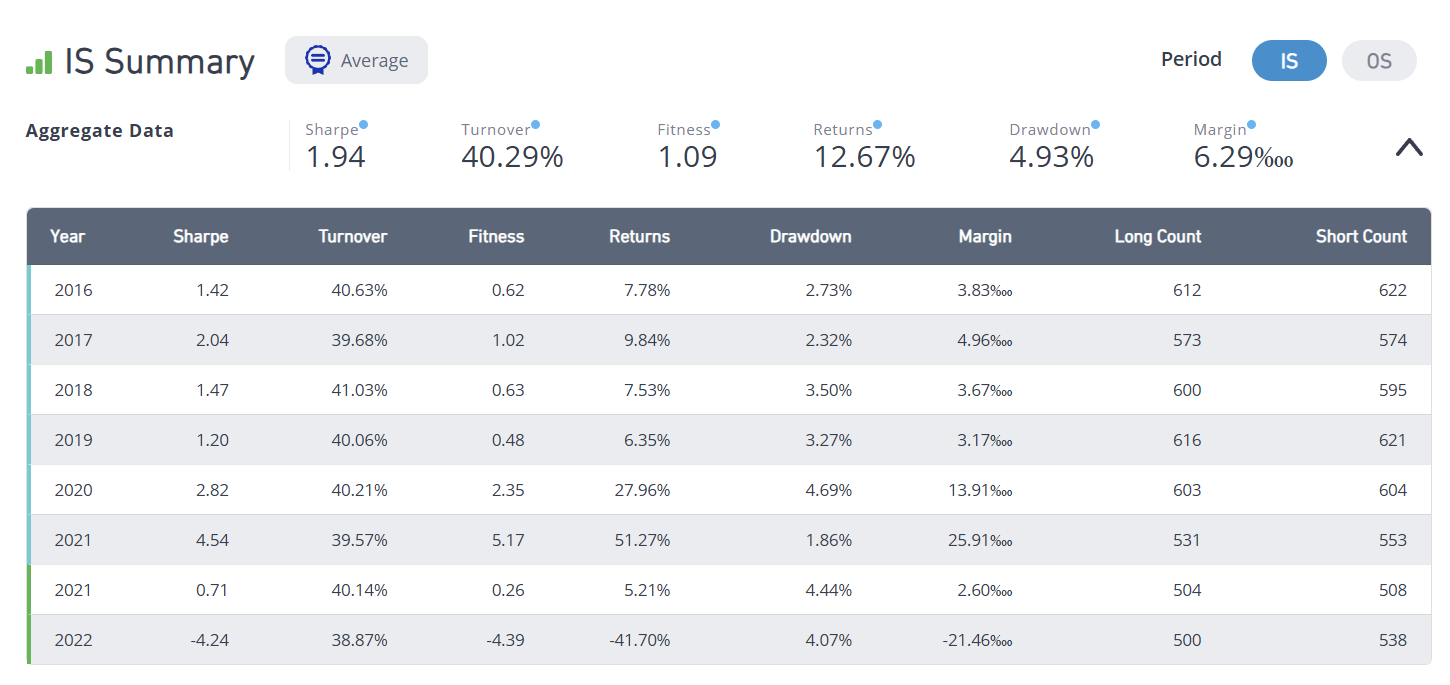
`Sharpe` -- Average measure of risk-adjusted returns
  * Sharpe = Avg. Annualized Returns / Annualized Std. Dev. of Returns
Turnover
`Turnover` -- Average measure of daily trading activity
  * Turnover = Value Traded / Value Held
Fitness
`Fitness` -- Hybrid metric for overall performance. Higher is better.
  * Fitness = Sharpe * Sqrt( Abs( Returns ) / Max( Turnover, 0.125 ) )
Returns
`Returns` -- Annualized average gain or loss as a fraction of the invested amount.
  * Invested amount is equal to half the book size
Margin
`Margin` -- Average gain or loss per dollar traded
  * PnL divided by total dollars traded in a given time period
Operators
Operators are building blocks
  * each one has a detailed explanation/math definition
  * add, subtract, mult, div -- be aware of units!
  * if/else, ternary
  * logical and, or, not
  * less/greater comparisons, eq/neq
Cross-sectional operators perform op across all stocks in universe at given point in time
  * rank, zscore, scale, sign
Time-series operators perform op on one stock across many points in time
  * tsdelta, tsdelay, tssum, tsmean, tsrank, tszscore, tsstddev, tsregression
Group operators are more powerful cross-sectional operators
  * Pick group like sector, industry, subindustry
Time-series regression
  * tsregression(y, x, window, lag, retval) -- y(t) = a + b * x(t-lag) for t in past window days. Returns error, a, b, estimate.
Cannot do cross-sectional correlation, only time-series correlation
Tradewhen operator activates between entry and exit conditions
  * Reduces turnover
  * Useful for trading during high-volatility times
Humpdecay -- return today's or yesterday's price, depending if change exceeds hump value
  * Reduces turnover
Good values
  * Truncation value = 0.01 for diversity
  * Reversion threshold = 0.55 because research show 50% time reversion, 10% momentum, 40% random
Price-Volume alpha
Ideas
Trend reversion
  * Short overbought stocks, buy cheap stocks
  * Useful in long-short frameworks
  * Works well during extreme price movements (overreaction)
    * Consider stddev to measure extreme price movements
    * Trade during times of high volatility
Try alpha `-(close - ts_mean(close, 5))`
  * Revert to weekly price, compared cross-sectionally
  * Uses absolute difference, so high prices are unfairly up-weighted
  * Long-short neutralization is performed to balance long and short positions
  * Wrap alpha with `rank` operator to get percentile? Helps with weighting
    * Good trick to improve diversity and performance
Reduce turnover = percent of portfolio traded per day ~ transaction costs!
  * Increase alpha decay
  * Combine operators
    * Also reduces correlation
example
summary